Peptide Pureness Overview 98%, 99% & Research-grade Clarified Prg Crude peptides are subjected to gel purification adhered to by HPLC filtration. HPLC purification is done by the state-of-art HPLC system with Empower Chromatography Manager. The system is validated by licensed Waters validation specialist to abide by FDA standards. The pureness of the peptide is verified by running analytical HPLC complied with by mass range evaluation. If you're using injectable peptides, endotoxin testing gives crucial safety details. This is specifically appropriate for injectable peptides where the administration course bypasses normal safety obstacles. Recognizing peptide safety and security and threats includes understanding that item top quality directly impacts safety results. Scientist regularly assess HPLC and mass spectrometry data.
- In basic terms, a peptide provided as 95% pure consists mainly of the target peptide (95%), with the staying ~ 5% made up of contaminations.The company has actually checked over 4,500 samples from greater than 169 suppliers, creating a considerable database of comparative quality information.At the end of the synthesis the peptides were cleaved off the material by reagent R (90% TFA, 5% Thioanisole, 3% Ethanedithiol, and 2% Anisole) and based on several ether extractions.Vendor COAs originate from the seller, producing prospective conflict of interest.For these high-stakes scenarios, the cost of screening is minor compared to prospective repercussions of using unverified products.For those adhering to peptides for skin tightening up methods, validated products ensure the protocol receives reasonable assessment.
What Documentation Do I Get?
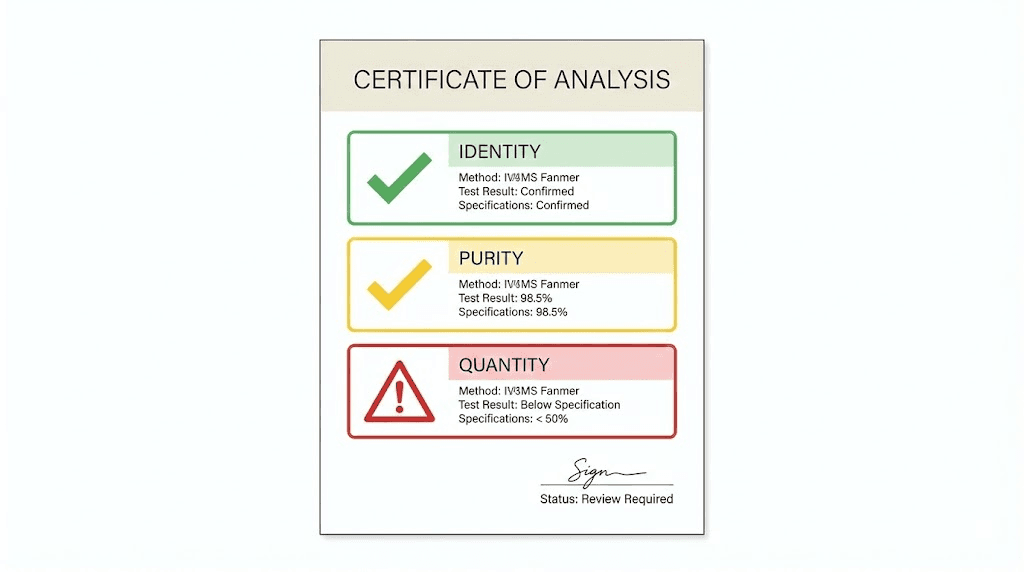
Poor-quality peptides (those with unseen impurities, inaccurate series, or broken down parts) can result in misleading data and irreproducible Research-grade peptides outcomes. In fact, healthy proteins and peptides are among one of the most commonly used lab reagents, yet research studies have shown that their top quality is typically insufficient, causing bad data reproducibility. Beginning with proper lab validation is therefore an essential part of a researcher's quality control operations. By demanding peptides that come with confirmation of purity and identification, researchers can greatly decrease the threat of experimental artefacts. This contributes to the bigger reproducibility situation in scientific research. On the other hand, making use of peptides that have actually passed third-party laboratory recognition aids make certain that the observed speculative results are absolutely as a result of the intended peptide and not due to impurities or mistakes. These logical techniques are typical in peptide quality control and you will often receive HPLC and MS information with a research peptide order. The main logical methods for peptides consist of liquid chromatography (LC), usually HPLC, integrated with mass spectrometry (MS) for accurate molecular weight resolution and series recognition. Various other techniques like electrophoresis, capillary electrophoresis (CE), and nuclear magnetic vibration (NMR) can also be made use of to assess peptide framework, charge, and pureness, ensuring thorough characterization. Peptides are tested via a mix of methods, consisting of HPLC for purity, mass spectrometry (MS) for sequence verification, and nuclear magnetic vibration (NMR) for architectural evaluation. Peptide screening is logical verification of a peptide sample. In COA testimonial, it normally consists of HPLC pureness testing, mass spectrometry identity confirmation, and batch-specific documentation showing the checked lot, technique, results, and date. With years of logical screening experience and advanced instrument platforms, BOC Sciences supplies extensive peptide top quality screening solutions across the whole procedure from raw materials to formulations. Third-party laboratory validation can significantly assist in this conformity procedure. The resulting information are formatted right into reports that regulatory authorities expect. Understanding what peptides are is foundational expertise, however understanding just how to verify their quality is what separates effective scientists from those that have problem with irregular outcomes. Mass spectrometry (MS) is utilized to verify the precise molecular weight and molecular identification of the compound, confirming the right amino acid series and eliminating replacement or architectural inconsistencies. Utilizing mass spectrometry, we verify the molecular structure and amino acid series. This is the only means to guarantee that the substance has the proper organic activity and is precisely what it asserts to be. The software application attracts boundaries around each peak and determines the area underneath.Where can I send my peptides to examine for purity?
ACS Peptide Testing Labs is a professional peptide evaluation lab that accepts examples from all 50 states. Whether you require to check peptide purity, confirm a provider''s Certificate of Analysis, or run comprehensive impurity screening, our laboratory provides quick, exact results with detailed reporting.

Peptide Applications In Functional Foods And Health Products
For example, BPC-157 (series GEPPPGKPADDAGLV) has a theoretical monoisotopic mass of 1,419.53 Da. A mass specification confirmation revealing [M+H] + of 1,420.54 (the protonated molecule) would certainly verify the proper molecular weight. An inconsistency of more than 0.5 Da recommends either a series mistake, an adjustment, or a different substance totally. " Mass spectrometry answers "is the detected compound consistent with the intended peptide identity? " With each other they supply more powerful batch-level evidence than either approach alone. HPLC can support insurance claims regarding chromatographic pureness, impurity top worry, and deterioration patterns when the method is suitable and the chromatogram is available.Peptide Quality Assurance Testing
For research-grade peptide credentials, HPLC and LC-MS/ESI-MS solution various concerns and must read together. MZ Biolabs offers third-party screening services referenced by numerous peptide vendors. The laboratory provides basic logical solutions consisting of HPLC and mass spectrometry evaluation.